| |
Quilting
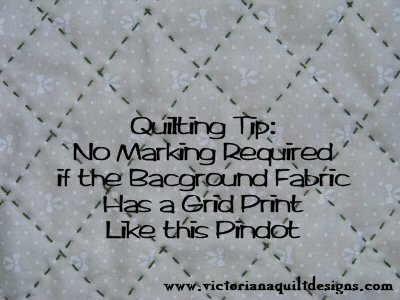
Tip: No Marking is required if the background fabric has a grid
print, like this pindot.
|
| |
|
| |
I
have often made a Triangular Label for a back corner of my quilts,
usually calico or a light colour to suit. Write your details across
with fabric pen and edge it with a strip of the binding fabric.
With the quilt ready for quilting, baste it on ,hand sew across
the diagonal,then bind as usual. It will be firmly in place on
two sides of the triangle with the binding stitches (machine or
hand sewing).......submitted by Barbara |
| |
|
| |
Springy
quilting cotton thread can be a nightmare to keep under control.
I use a quarter inch wide elastic band and put it around the middle
of the spool. This works wonders and you don't have to remove
it when you use the thread......submitted by Jane |
| |
|
| |
For
hand quilting trace the various sections of the motif (eg. 4 wings
& body for a butterfly) onto freezer paper. Cut out the pieces
& iron them where you want the design. Quilt around each section.
I can layer the freezer paper if I want to cut out several motifs
at one time.
When stitching is finished pull off the freezer paper sections
and re-iron onto the next areas......submitted by Connie |
| |
|
| |
When
I make a quilt, I use the left over fabric to make a matching
pillow case that doubles as a storage bag. This makes it easy
to identify what quilt I have stored......submitted by Sheila |
| |
|
| |
To
the back of my quilts I like to attach a hanging sleeve, made
up of the fabrics used in a quilt. Then if it needs to be repaired
the same fabric will be available......Submitted by Myra |
| |
|
| |
It's
helpful to lay your quilt batting out flat for a day before using
it, to allow the wrinkles to relax.....Submitted by Sandra |
| |
|
| |
I
embroider my name in tiny letters hidden in one of the blocks.
My grandchildren love to search and search to find it...............Submitted
by Jilly |
| |
|
| |
When
free-motion quilting my quilt, I like to 'sign' my name in a corner..............Submitted
by Cathy |
| |
|
| |
I
have favourite embroidery needles to use when hand sewing my binding
on. To save time trying to find them I keep them in the clear
plastic box with my binding clips.............Submitted
by Carol |
| |
|
| |
To
keep my lines straight when hand printing a quilt label, I press
a piece of freezer paper which I have drawn lines on, underneath
to use as a guide............Submitted by Beth |
| |
|
| |
I
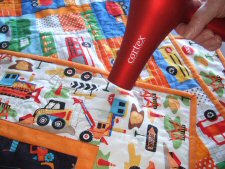
have just quilted the border of a large bed quilt and today was
about to remove the black marked lines that I had made by using
one of the Pilot Frixion marking pens that require heat to make
the marking disappear - but I didn't want to flatten the quilting,
and hovering over all the marking with a heavy iron was not appealing
- so I used a hair-drier instead and all the marks had gone in
no time at all - much faster, more efficient and no aching arm
from hovering with an iron............Submitted by Pauline
|
| |
|
| |
To
organize your plastic stencils, keep them together on round rings.
Hang the rings on a hook to keep them from getting bent..............Submitted
by Anna |
| |
|
| |
I
have favourite embroidery needles to use when hand sewing my binding
on, which I keep in the clear plastic box with my binding clips.
This saves time trying to find them.............Submitted
by Carol |
| |
|
| |
I
like to use contact paper (rolls purchased from a dollar store)
to mark my quilt top for quilting.
As I don't like to mark my quilt top unless necessary, these work
so well. Staple multiple layers together and cut out the motif
from the center to stick them to the quilt top. They will stick
several times before they no longer stick well and need replacing..................Submitted
by Kirsty |
| |
|
| |
What
I like to do when I hand baste my quilt, is thread the needle
leaving the other end attached to the spool. This method allows
me to never run out of thread as I baste across the quilt! You
gently pull the long thread through the fabric, which comes off
the spool, until I'm across the quilt.................Submitted
by Karen |
| |
|
| |
To
transfer quilting designs through the holes of stencils, I like
to use a foam paint brush to apply the powder...............Submitted
by Betty |
| |
|
| |
When
hand sewing or quilting, I like to pre-thread a bunch of needles
so I don't have to stop stitching to re-thread...........submitted
by Tina |
| |
|
| |
I'm
making up some pieced backings in advance out of some of the fabric
I don't love as much anymore. This will use that up these pieces
of fabric and allow me to have backings ready to use for my donation
quilts .........submitted by Ann |
| |
|
| |
I
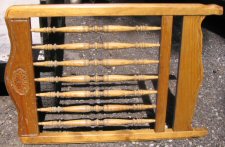
found a baby bed frame sitting out for the trash. I see the possibilities
of a solid wood quilt rack to hang on the wall to show my quilts.
I think I will paint it white. It will need some 6 inches spacers
attached at the corners to give some clearance from the wall.
I have seen quilt stores use bed frames to show off their quilts
on the wall, so I thought about this baby bed when I saw it and
decided to make a refurbished quilt rack with it instead of letting
it go to the junk pile. Best of all it's Free!! .........submitted
by Debbie
|
| |
|
| |
I
cut a small strip from an unusable rubber glove (wide rubber bands
also work) to use for pulling the quilting needle through. It
saves me from using the plyers I also keep for the same purpose.......submitted
by Janet |
| |
|
| |
When
I machine quilt I practice in the 4" to 5" of extra
batting and backing fabric that I layer my quilt top on.......submitted
by Jean |
| |
|
| |
When
I use a wash-away pen for marking, I keep a little sponge topped
“postage stamp” bottle filled with water to get rid of the markings.
You can find these at most office supply stores........submitted
by Sarah |
| |
|
| |
I've
started to use a crochet hook to close my basting pins, with good
results, saving my hands......submitted by Penny |
| |
|
| |
When
I make a quilt, I like to make a smaller version of the quilt
block in the pattern to use as my quilt label on the back of the
quilt.
Adding the name, date, and other label information in permanent
fabric pen makes a nice finishing touch........submitted by
Nancy |
| |
|
| |
I
like to use some of the leftover fabric to make a storage bag
for the quilt to be stored in. They could be made with a hook
and eye tape flap in the shape of an envelope or with a draw string.......submitted
by Genny |
| |
|
| |
When
you prick your finger while quilting and have gotten blood on
your work, scrunch up a small wad of quilting thread scraps, add
some saliva (your own saliva for your own blood) and rub the spot.
It removes the blood nicely.......submitted by Elaine |
| |
|
| |
While
hand quilting I put a piece of batting in the end of the spool
of thread. This allows me to keep some pins and needles with the
thread.......submitted by Shirley |
| |
|
| |
For
a quick easy quilt for kids or travelling, I use fleece on the
back instead of batting and backing fabric.......submitted
by Jill |
| |
|
| |
I
like to include a printed-on-fabric picture of the child I make
a quilt for, as part of my label.......submitted by Elizabeth |
| |
|
| |
When
I've made binding for a quilt I wrap my pressed and folded binding
on either toilet paper or paper cardboard cylinders depending
on how much I'm going to have. When applying it, I drop the holder
with the bias binding into a large empty gallon jug on the floor
at my feet. It stays smooth, doesn't get tangled, and stays under
control.......submitted by Joyce |
| |
|
| |
When
quilting a diagonal grid across a quilt I like to use a double
line. This adds a nice detail and avoids going through the extra
fabric at each corner.......submitted by Teresa |
| |
|
| |
For
backing material, I find the off the roll from a store can sometimes
work out to be quite expensive so I have purchased a cotton sheet
the size I required and found it alot less money. [Please
Note: Sheets can be hard to hand quilt through, and this
works best for machine quilting].......submitted by Ann |
| |
|
| |
An
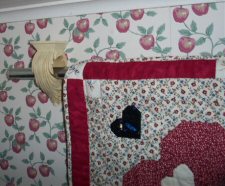
easy way to hang a quilt, with a drapery rod on a wall, is with
a pair of drapery sconces from a dollar store. These can be painted
to blend or match your wall colour.......submitted by Diana
|
| |
|
| |
When
I am joining batting together, I overlap the two pieces about
3". Then I take my rotary cutter and make continuous smooth
curves. I take off the excess batting and put the two pieces together
like a puzzle. Using a big needle and long thread I zig zag my
stitching along the cut lines pulling the pieces together. I use
rather long stitches. By doing this, I do not have a straight
line showing in my quilt and the quilting further holds the quilt
batt together......submitted by Rhonda |
| |
|
| |
To
keep binding neat and orderly roll up the binding after pressing
your binding in half. Then take an clean butter tub and cut a
1½" to 2" slit in the side.
Place the rolled up binding into the tub and feed the end of the
binding thru the hole. Cover with the tub lid. Place the butter
tub either between your knees, or on the floor by your foot pedal
or feet. As you sew the binding to the quilt edge, the binding
slowly feeds out and doesn't tangle......submitted by Fran |
| |
|
| |
A
good "no marking" method for machine quilting is to
use tracing paper or regular tissue paper to mark your designs
on, with a permanent marker. Pin them onto your quilt and quilt
on the lines. When finished, just tear away the paper from your
quilt......submitted by Katie |
| |
|
 |
Using
plain metal hair clips to hold binding down while sewing, is much
less painful than pins & they can be purchased inexpensively
at bargain shops......submitted by Olga |
| |
|
|
The
newest quilting tool that has the online quilting world abuzz
with excitement is Glad Press and Seal. It can be used for appliqué,
transferring quilting designs and as a stabilizer. The thin film
tears away easily, and you can even print your designs on it with
a printer..........submitted by Cyberquilters |
| |
|
|
Some
of the large balls of crochet cotton are soft enough to be used
instead of the more expensive sashiko threads in quilting.......
submitted by Muffin |
| |
|
|
A
way to transfer a quilting design, is to trace the design onto
a piece of netting. Lay the netting over the fabric and trace
the design onto your quilt top, using a chalk marker......
submitted by Helen |
| |
|
|
A
way to mark a copy of a quilting design onto your quilt: Sew,
with your sewing machine (no thread), the quilting design.
Put a tablespoon of cornstarch (cocoa or cinnamon for lighter
fabrics) into a 4" circle of loose woven cotton. Tie into
a pounce ball.
Pat the pounce ball over the holes in the design to mark the design
on your quilt. |
| |
|
|
A
quick and easy method for tying quilts.....
Using any color, not too thick crochet cotton, thread your needle
leaving a very long piece, or even leave it connected to the ball
of thread. Go along every 4" or so, making one stitch after another,
without cutting the thread, through a long area (top to bottom
of quilt, for example). Then cut the thread, and cut between each
stitch, leaving enough to tie each "square knot". Tie each knot
(I use the surgeons' knot, where you just tie 2 square knots,
instead of one) Then go along and snip off the ends of each knot
to about ¾"......Submitted by Mary |
| |
|
|
The
little binder clips they sell at office supply stores that are
like a clamp, work great when sewing the binding.... better than
trying to stick a pin through all the layers....Submitted by
Jennifer |
| |
|